The Real AI Side Hustle Is Live on Amazon
My first book is live on Amazon — the honest result of testing the '$10k/month with AI' methods every YouTuber sells. What the process took, and what's next.
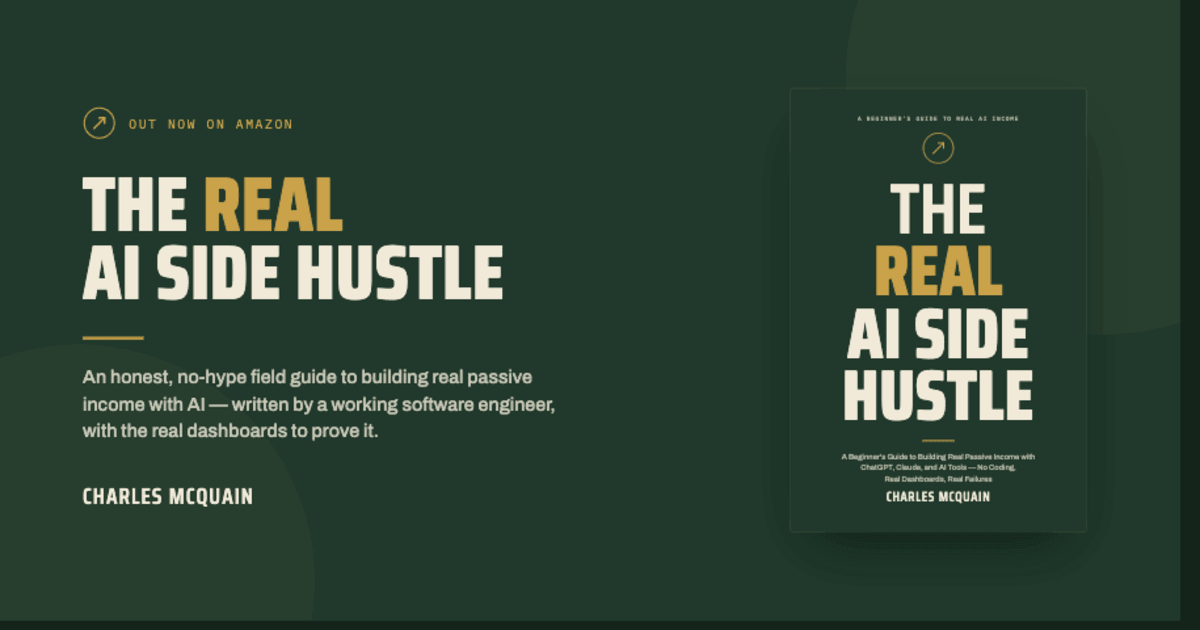
The Real AI Side Hustle is live on Amazon — as a Kindle eBook ($9.99) and a paperback ($14.99), both up as of June 24, 2026.
I submitted to KDP two days ago. The stated review window is 72 hours, and I’d braced for the full three days plus a decent chance of a rejection over formatting. Instead both formats cleared in 48. I refreshed the dashboard, saw Live, and just sort of sat there for a minute.
(The Kindle eBook reads on any phone, tablet, or computer with the free Kindle app — you don’t need a Kindle device.)
So it’s real. You can buy it. And here’s what actually went into it — the honest version, because honest is the whole point of the book.
Where it started
This started as an experiment. I’d watched the same videos you have — the YouTubers boasting $10k, $20k, $50k a month from AI side hustles, screenshots and all — and I wanted to know what was actually real underneath the thumbnails. So I ran the methods myself, for months, and kept honest records of what happened. The book is that record: not the highlight reel, but what the work actually looked like, what it actually earned, and where it fell on its face.
What this book actually is
It is not a “$10,000 a month in passive income” promise. There’s no Lamborghini screenshot. There’s no course waiting at the end.
What it is: an account of the AI income paths I’ve actually run, taught through real, redacted dashboards from projects that exist. Five affiliate content sites. A product on Etsy. A free tool I built on Lovable — Vaultano, which is live right now and yours to use. A SaaS attempt that didn’t pan out and pivoted. And the book itself.
The category this lands in is crowded with AI personas — confident faces attached to no verifiable project, selling the idea of income instead of the evidence of it. The thing I can offer that they can’t is simple: I’m a real engineer in Texas with a name you can look up, and every number in the book comes from something I actually built and run. Honesty is the floor. The proof is the edge.
The affiliate content path is the one I teach deepest — that’s where most of the method lives. I keep the specific niches and domains out of it on purpose. The book teaches the method, not a map to copy.
How it actually got made
Eleven chapters across four parts, plus front matter, appendices, and a Notes & Sources section — written tight, with nothing padded out. I’d rather you finish it.
The workflow was AI-assisted start to finish, and I’m not going to pretend otherwise. It’s a book about using AI tools, written with AI tools — Claude was my drafting and editing partner. But there was one rule I never broke: no invented stories, no invented numbers. I’d brain-dump the real material — what I did, what it earned, the screenshots — Claude drafted from that, then I voice-edited it back into something that sounds like me. Draft, review, polish, final. The words got a lot of help. The facts were all mine.
The review step is the part I’m proudest of. Every chapter went through a simulated eight-reader panel — eight archetypes held in mind at once: a skeptical engineer, a budget-conscious side-hustler, a stay-at-home parent, a technical fact-checker, a few others. Four full rounds across the whole book. The bar was 8/8 on three questions — would you keep reading, would you recommend it, do you want a sequel — and a chapter didn’t move forward until it hit 8/8.
The cover
The cover came out of Claude Design. I generated a set of options, ran them past a three-expert review, and then did the test that actually mattered: I put them in front of my wife with no context and asked which one she’d stop scrolling on. She picked one immediately, unprompted. That’s the one.
It’s called Forest & Gold — a dark forest-green background (#20392C), cream text, a gold accent. The cold-scroll pick beat my own favorite. Which is exactly why you run the test instead of trusting your gut.
Formatting was its own little project
Here’s the part nobody warns you about: writing the book and producing the file Amazon will accept are two different jobs.
I wrote everything in Markdown — twenty-plus files — and a small Python build script compiled them into a single DOCX. That went into Vellum, a $250 one-time Mac app, which produced the Kindle EPUB and the print-ready PDF.
One sharp edge: Vellum flattens Markdown tables into plain text, which quietly wrecked every comparison table in the book. The fix was to stop using tables — I rendered each one as a PNG image instead, generated programmatically with Python and matplotlib, and dropped those in. Not elegant. Worked.
And the meta part I still grin about: the book is itself one of the income streams documented inside the book. I’m using KDP as a case study in a book I’m publishing through KDP. I couldn’t have planned that any cleaner if I’d tried.
A real thank-you
My wife — first, last, and throughout. She carried more than her share of everything while I disappeared into this for months, and on the days I wasn’t sure it was worth finishing, she was the one who was sure. The cover test was just the visible part of it.
Everyone who’s followed the build-in-public posts — the folks reading along as this went from a 17-chapter outline to a finished thing — thank you for the company. And if you’ve already bought a copy or pointed someone toward it: genuinely, thank you. Launch day for a first book is a quiet thing, and every one of those counts more than the number suggests.
What happens next
I’m not done — I’m just pointing the same build-in-public lens at something new. I’m about to start work on a new app, built in the open the same way the book was, and I’ll have real details to share before long. They’ll land here on the blog first. If you want to follow what a working engineer actually ships next — the messy middle included — this is the place.
There’s also a free companion page for readers — a Prompt Library with copy-to-clipboard prompts, a Niche Validation Worksheet, a Site Setup Checklist, a Tool Stack Reference Card, and a Directory Submission List. No purchase required to grab them.
That’s it. The book is live.
- Kindle eBook — $9.99 · amazon.com/dp/B0H6HKXXL3
- Paperback — $14.99 · amazon.com/dp/B0H6HNDNWB
- Free reader resources · charlesmcquain.dev/books/ai-income
Build-in-public, honestly.
Real AI-side-income numbers, the systems behind a solo content portfolio, and the engineering decisions along the way. No hype, no spam.